
 SURGICAL SECOND OPINION • SPINE & SCIATICA
Spine Fusion & Discectomy Surgical Second Opinion
Advised spinal fusion (TLIF/PLIF) or microdiscectomy for back pain, sciatica, or disc herniation? Get an objective scan review from senior spine surgeons.
✔ When to Request This Second Opinion
- • Recommended lumbar spinal fusion (TLIF/PLIF/MIS), laminectomy, or microdiscectomy
- • Suffering from chronic lower back pain, sciatica, or radiating leg numbness
- • Diagnosed with slip disc (L4-L5 or L5-S1), spondylolisthesis, or spinal canal stenosis
- • Looking to evaluate targeted transforaminal epidural injections before agreeing to surgery
📁 Imaging & Records to Upload
- 📄 Recent High-Resolution Lumbar Spine MRI (T1, T2 axial and sagittal cuts)
- 📄 Dynamic X-Rays (Flexion and Extension views if spondylolisthesis is suspected)
- 📄 Electromyography (EMG) or Nerve Conduction Studies (if available)
💡 You can upload photos of your scan films taken with your mobile phone against a window or white laptop screen, or PDF radiologist reports.
Signed Expert Deliverable
What Our Spine Review Delivers
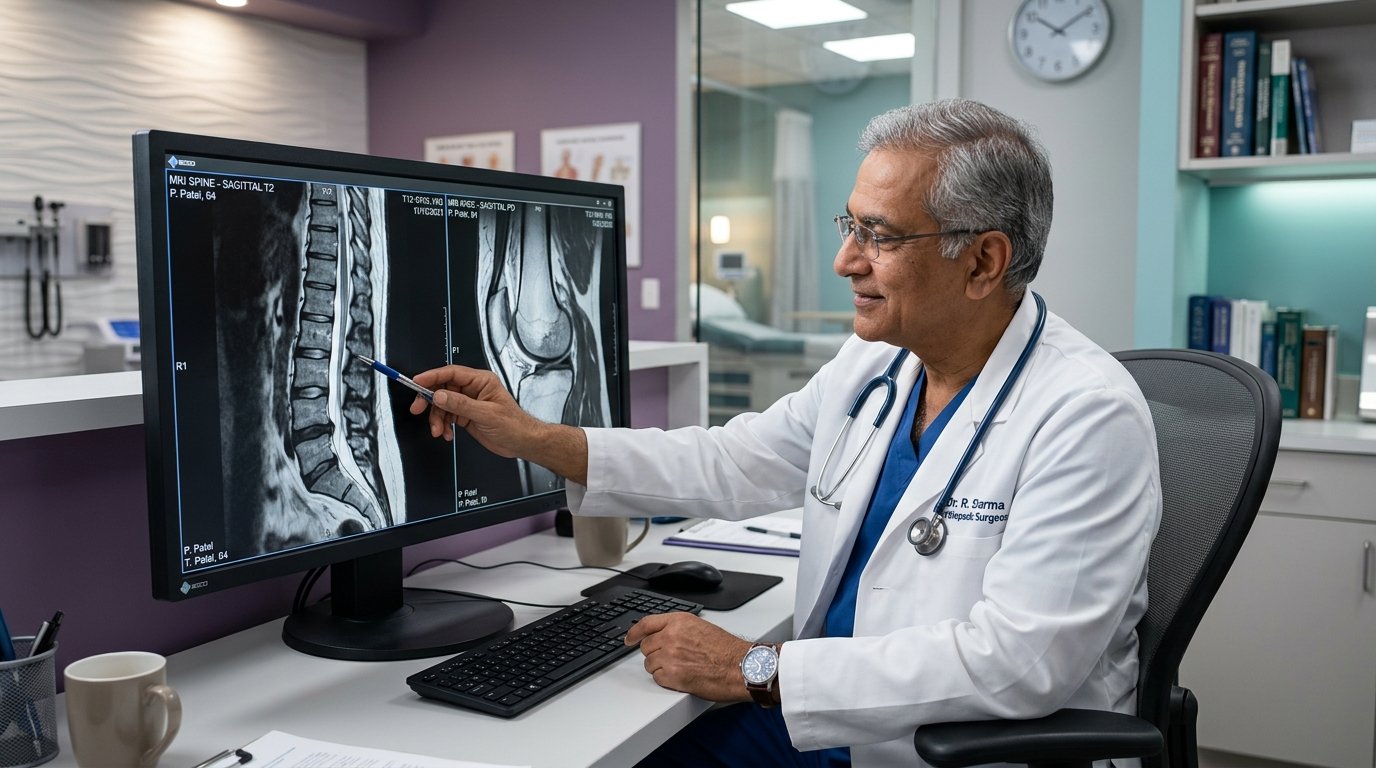
We clarify whether your radiating nerve pain matches the MRI disc level, quantify spinal canal narrowing, evaluate mechanical spinal instability, and give you an evidence-based surgical necessity score.
Frequently Asked Questions
In over 85% to 90% of lumbar disc herniations, sciatica and radiating leg pain resolve naturally within 6 to 12 weeks with anti-inflammatories, neural mobilization, core physical therapy, or targeted epidural injections. Surgery is strictly indicated for progressive neurological deficit (loss of foot strength), cauda equina syndrome, or intolerable pain lasting over 3 months despite conservative therapy.
Sudden loss of bowel or bladder control, numbness in the saddle area (inner thighs and groin), or progressive leg weakness (such as foot drop where your toes catch while walking) indicate Cauda Equina Syndrome or acute nerve root compression requiring surgical decompression within 24–48 hours.
A microdiscectomy removes only the herniated disc fragment pressing on the spinal nerve root through a 1-inch minimally invasive incision, leaving the spine intact. A spinal fusion removes the disc, places an interbody cage with bone graft, and permanently fuses the vertebrae using titanium pedicle screws and rods. Fusion is only needed if spinal instability (spondylolisthesis) is present.
No, this is an outdated myth. In modern spine surgery with intraoperative neurological monitoring (IONM) and high-power microscopes, the risk of permanent nerve damage or paralysis in lumbar surgery is less than 0.1%. Lumbar surgery operates below the spinal cord (conus medullaris ends at L1-L2), working only on individual nerve roots (cauda equina).
Yes! MRI scans frequently detect disc bulges, protrusions, and degenerative changes in completely pain-free individuals. Over 40% of adults over 35 have asymptomatic disc bulges. Treatment must always target your clinical nerve symptoms rather than treating the MRI report in isolation.
A transforaminal epidural steroid injection delivers targeted anti-inflammatory corticosteroid directly around the inflamed nerve root under fluoroscopic (X-ray) guidance. It provides significant pain relief in 70% of acute sciatica cases, creating a pain-free window for physical therapy and natural disc resorption.
For microdiscectomy, patients walk within 4–6 hours after surgery and are discharged the same day or within 24 hours. Desk work can resume in 2 to 3 weeks. For spinal fusion, hospital stay is 2 to 4 days, with full bone fusion taking 3 to 6 months.
Fusing one lumbar level (e.g., L4-L5 or L5-S1) results in minimal noticeable loss of overall spinal motion, as hip joints and remaining lumbar discs compensate. Patients can bend to tie shoes and perform daily living tasks once fused. However, extreme contact sports or heavy deadlifting are restricted.
When one spinal level is locked rigid with screws and rods, increased mechanical stress is transferred to the disc segments immediately above and below it. Over 10 years, roughly 15–20% of patients may develop wear and tear at the adjacent level. Our panel evaluates whether motion-preserving decompression can be done without fusion.
Recurrent disc herniation at the same level occurs in approximately 5% to 8% of cases within the first 2 years, usually because the outer annular tear needs time to scar down. Maintaining core muscular strength and spinal ergonomics reduces recurrence risk significantly.
A lumbar microdiscectomy typically costs between ₹1,20,000 and ₹1,90,000. A single-level lumbar spinal fusion (TLIF) with titanium implants costs between ₹2,20,000 and ₹3,50,000 depending on implant brands and hospital room category.
Yes, all major medical insurance policies cover spine surgeries that are medically necessary and pre-authorized. Minimally invasive techniques and implants are covered subject to policy limits.
Swimming and specific McGill core stability exercises are gold-standard conservative therapies. Gentle yoga without extreme flexion or twisting strengthens the posterior chain. Aggressive forceful chiropractic neck or lumbar thrust manipulation should be avoided in acute disc protrusions.
Alarmist MRI reports describing canal narrowing or nerve abutment often induce panic. Without correlating clinical reflex tests, dermatomal pain maps, and EMG studies, surgeons may prematurely recommend multi-level fusions. Our independent panel ensures surgery is recommended only when indisputably required.
Our senior spine surgeons review your raw DICOM MRI axial and sagittal cuts, assess disc hydration, nerve root canal clearance, mechanical instability on flexion-extension X-rays, and cross-reference with your reported symptom distribution to assign an objective surgical necessity score.
Next Steps for Spine Fusion & Lumbar Disc Surgery Second Opinion
Ready to Gain Clinical Certainty?
Choose between a secure online scan evaluation or an in-person consultation at our Pune clinics.